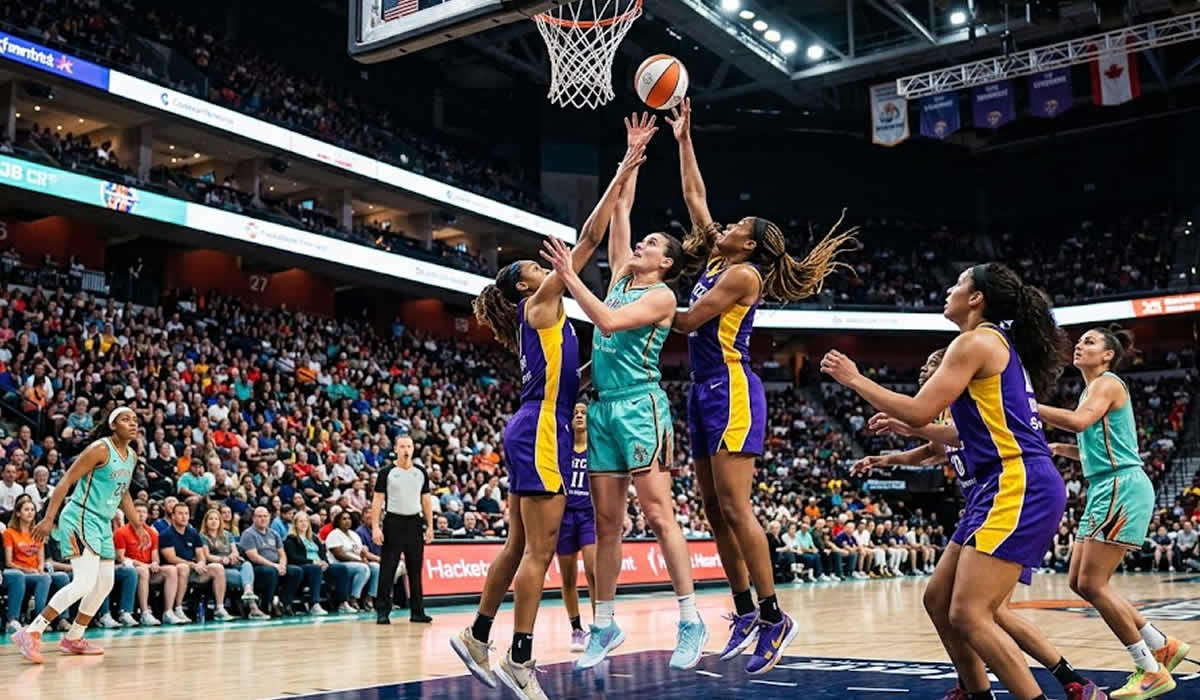
The WNBA has spent decades fighting for attention, and now that it finally has an audience, it seems determined to turn basketball into a never-ending argument about race, sexuality, victimhood and politics. The league’s public image is increasingly defined by its outspoken Black players, prominent lesbian culture and a political atmosphere in which questioning the prevailing narrative can get you branded a bigot.
The problem isn’t that the league has Black players or lesbian players. It’s the impression that certain players, fans and commentators expect their views to be treated as beyond criticism, while everyone else is expected to shut up and applaud. Racism is rightly condemned when directed at Black players, but what about racial hostility directed at White players? Why does the conversation so often become a lecture about discrimination when a Black player is involved, yet appear considerably less interested in the same standards when the target is White?
Then there’s the officiating, the endless social-media drama and the spectacle of former NBA players declaring their intention to enter the WNBA Draft to challenge the league’s gender-eligibility rules. The WNBA has become a cultural battleground where the actual basketball can sometimes feel like an afterthought.
For a league finally attracting serious attention, it has an extraordinary talent for making itself look ridiculous.
Is a prick because…
1. A league dominated by Black players and a prominent lesbian culture
The WNBA has a distinctly political and cultural identity, shaped by its predominantly Black player base and its prominent lesbian and LGBTQ+ community. That is not inherently a problem. The problem is when sections of the surrounding culture treat criticism as an attack on identity itself, rather than an ordinary part of professional sport. Being a minority does not make anyone immune to scrutiny, and being outspoken does not automatically make someone right.
2. The apparent double standard on racism
Racism against Black players deserves condemnation. So does racism against White players. Yet public debates around the league can create the impression that racial hostility is taken more seriously in one direction than the other. If a White player is mocked, stereotyped or targeted because of their race, the response should not depend on whether the victim fits somebody’s preferred political narrative. Equal treatment cannot mean equal treatment only when convenient.
3. Caitlin Clark became a culture-war football
Clark’s popularity brought enormous attention to women’s basketball, but discussion of her success has repeatedly been dragged into arguments about race, privilege, jealousy and who deserves credit for growing the game. Some criticism of Clark is perfectly legitimate. The problem is the tendency to turn her into a symbol in a racial argument instead of judging her as a basketball player. When every achievement becomes a political provocation, sport loses and the outrage merchants win.
4. The officiating inspires too much suspicion
The league cannot expect fans to trust its officials if controversial calls repeatedly become the story. Inconsistency, questionable contact decisions and arguments over player protection fuel suspicions that some stars receive different treatment. Those suspicions should be judged against the actual evidence, not simply accepted as fact, but the league has a responsibility to make its officiating credible. Fans should be debating basketball, not wondering whether the rulebook changes depending on the player involved.
5. Politics and identity are swallowing the sport
Players are entitled to political opinions, and fans are entitled to disagree with them. But the WNBA’s public image is increasingly entangled with arguments about race, gender and ideology. The league cannot simultaneously court a wider audience and act surprised when people question its politics, its public statements or the behaviour of its players. A professional basketball league should not need every match to double as a referendum on American culture.
6. The WNBA Draft gender controversy exposed an obvious weakness
Former NBA players Enes Kanter Freedom and Royce White announced intentions to enter the 2027 WNBA Draft while claiming to identify as women. The league subsequently deemed them ineligible, according to reports. Their declarations were widely viewed as provocations designed to test the league’s position on transgender participation. The WNBA should have clear, defensible eligibility rules that protect the integrity of women’s competition. Leaving room for public confusion invites stunts, political grandstanding and entirely avoidable controversy.
7. The league sometimes looks more interested in outrage than accountability
The WNBA has legitimate issues to address, including player safety, officiating, professionalism and the treatment of athletes online. Yet those issues can get buried beneath the latest social-media feud or political row. A league that wants to be taken seriously needs to demonstrate that standards apply to everyone, regardless of race, sexuality, popularity or political allegiance.
Is not a prick because…
1. The basketball is genuinely improving its reach
The league has attracted more viewers, investment and attention. That growth is real, and the players deserve credit for the quality of competition that has helped bring new fans through the door.
2. Black and lesbian players are not the problem simply for existing
A league’s racial makeup or the sexuality of its players is not evidence of wrongdoing. The criticism should concern behaviour, double standards and institutional decisions, not the mere existence of a particular group of people.
3. Players have every right to speak their minds
Athletes should not have to remain silent about politics, discrimination or personal beliefs. That freedom, however, works both ways. Players can express their views, and the public can challenge them without every disagreement automatically being labelled hateful.
4. The league is right to reject publicity stunts
The Kanter Freedom and Royce White episode exposed a genuine need for clear eligibility rules. The WNBA was entitled to assess their eligibility under its governing agreement rather than allowing a pair of headline-grabbing declarations to dictate league policy.
5. Women’s professional basketball deserves to succeed
The players have worked hard to reach the highest level of their sport. They deserve proper pay, professional facilities, consistent officiating and protection from genuine abuse. None of that requires fans to agree with every political position expressed by the league or its players.
6. The WNBA still has a chance to grow up
The league has the audience and the talent to become a much bigger sporting attraction. It needs to focus on the game, apply consistent standards, clarify its rules and stop allowing every controversy to become an identity-driven shouting match. That would do more for its reputation than another round of moral lectures or social-media warfare.