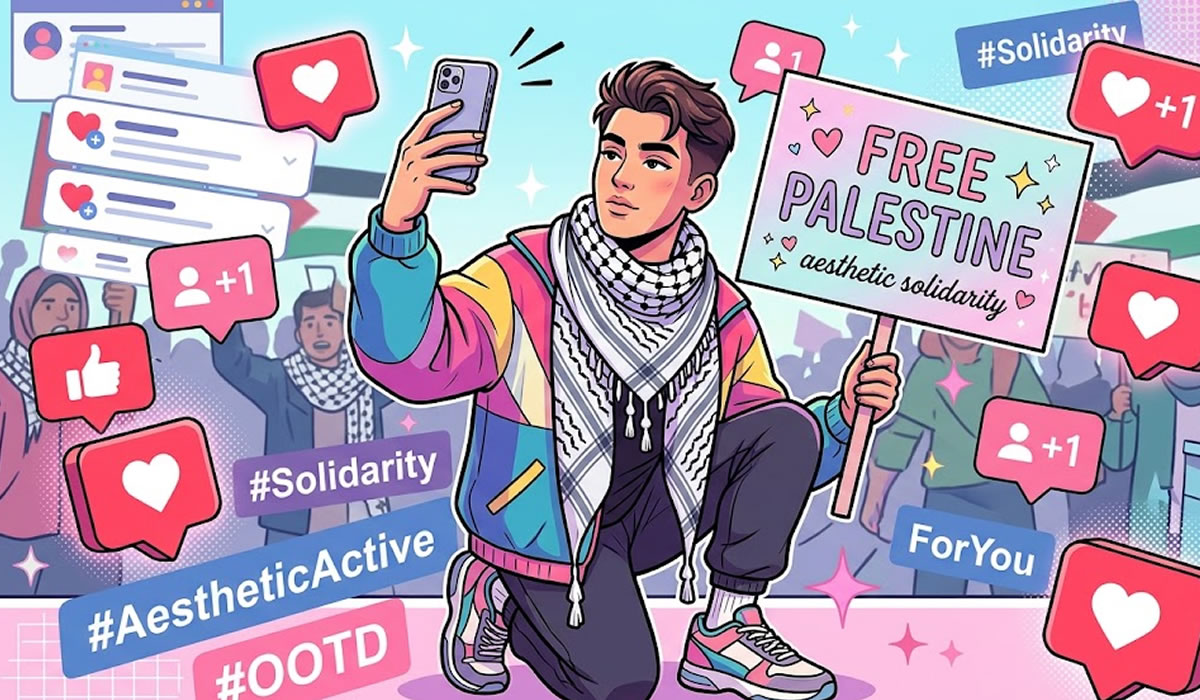
There is a particular breed of political activist who appears to believe that waving a Palestinian flag, shouting a few slogans and glowering at America automatically makes them an intellectual heavyweight and a moral giant. They have discovered the perfect combination: a fashionable cause, a ready-made villain, a crowd to hide in and an endless supply of social media opportunities to demonstrate just how magnificently compassionate they are. Welcome to the professional outrage industry, where knowing the history is optional, understanding the politics is negotiable, and looking suitably furious for the camera is practically a university qualification.
For some of these people, Palestine appears to be less a humanitarian cause than a vehicle for their own vanity. They turn up with flags, chant words they struggle to explain, accuse anyone who questions them of supporting atrocities, and congratulate themselves for their extraordinary bravery in opposing the United States while enjoying every freedom that the country and its allies have helped defend. Their understanding of the Middle East can be astonishingly shallow, yet their certainty is bottomless. They have the confidence of a professor, the geopolitical knowledge of a sandwich board and the self-awareness of a parking meter.
Even if you’re on the side of an independent Palestine, these pricks make it hard.
And the anti-Americanism is difficult to miss. For some activists, Israel is simply the latest battlefield in a much older obsession with portraying America and the West as the source of every evil on Earth. They will condemn Washington for supporting Israel, but how many have spent a fraction of the same energy examining Vladimir Putin’s invasion of Ukraine, Xi Jinping’s repression of Uyghurs, or the persecution of Christian communities facing massacres and displacement in parts of Africa and the Middle East? Apparently, certain dictators are less interesting when criticising them doesn’t fit the fashionable anti-Western script.
Then there is the remarkable selective memory surrounding Israel itself. Israel exists in a region where armed organisations such as Hamas and Hezbollah have attacked it, while Iran’s leadership has repeatedly called for Israel’s destruction. Hamas’s 7 October 2023 attacks killed civilians and involved hostage-taking. None of this makes every Israeli government action defensible, nor does it erase Palestinian suffering. But the idea that Israel exists in some geopolitical vacuum, free from hostile armed groups and governments, is fantasy. You can oppose Israeli policies without pretending the threats facing Israeli civilians are imaginary.
And where does that leave the flag-waving brigade? Some are serious, informed people who genuinely care about Palestinian lives. Others seem to have discovered that being aggressively anti-Israel is a convenient way to advertise their anti-American credentials, collect approval from their ideological peers and feel morally superior without having to grapple with inconvenient facts. The Palestinian flag becomes a prop, the protest becomes a performance, and the suffering of millions becomes the backdrop to somebody else’s heroic self-image.
The Palestinians deserve better than that. So do Israelis, Ukrainians, Uyghurs and persecuted Christians. Human suffering is not a competition, and human rights should not depend on which geopolitical team happens to be fashionable this week.
Are pricks because…
- Queers for Palestine: A Bizarre Contradiction. There is something breathtakingly ironic about LGBTQ+ activists championing a movement associated with a society where homosexuality faces severe stigma and Hamas has persecuted and killed people accused of collaboration or violating its rules. Supporting Palestinian civilians is one thing; ignoring the hostility LGBTQ+ people can face in the name of political solidarity is quite another.
- They confuse a flag with an education. Waving a Palestinian flag does not magically install a working knowledge of Ottoman history, British Mandate Palestine, the 1947 partition plan, the Arab-Israeli wars, Hamas or the Oslo Accords. Yet some protesters parade around with the certainty of senior diplomats despite being unable to explain the basics without consulting a social media infographic. If your geopolitical education began with a TikTok video, perhaps hold off on lecturing everyone else.
- For some, anti-Americanism is the real attraction. There are activists who seem less interested in the details of Palestinian statehood than in having another opportunity to denounce America. Washington supports Israel, therefore Washington is evil; Israel fights an armed group, therefore Israel must be the sole villain; anyone who challenges this simplistic worldview must be a fascist. It is a child’s understanding of international politics dressed up in revolutionary merchandise.
- Putin gets a fraction of the theatrical outrage. Russia launched its full-scale invasion of Ukraine in February 2022, and Ukrainian civilians have endured years of attacks, displacement and destruction. Yet where are all the equivalent mass demonstrations, campus encampments and social media performances demanding that Putin be held accountable? Some people do protest Russia, of course. The question is why the same activists who can organise elaborate demonstrations against Israel sometimes seem remarkably less interested in confronting an expansionist dictator whose actions have devastated an entire neighbouring country.
- Xi Jinping’s victims don’t seem fashionable enough. China’s treatment of Uyghurs has been extensively documented, alongside repression in Tibet, Hong Kong and against unofficial Christian churches. Human Rights Watch has continued to report severe repression under Xi. Where is the equivalent enthusiasm for confronting Beijing? Where are the endless lectures about Chinese authoritarianism? If your outrage evaporates when the perpetrator is a powerful Western rival, your commitment to universal human rights looks suspiciously conditional.
- Persecuted Christians rarely get the same celebrity treatment. Christian communities in countries including Nigeria and Syria have faced killings, displacement and serious persecution, alongside other religious and ethnic minorities. These victims deserve attention and protection. Yet their suffering rarely becomes the same sort of fashionable international identity project. There is no shortage of genuine reasons to protest for Palestinians; the hypocrisy lies in treating some victims as a moral emergency and others as an inconvenient distraction.
- They forget that Israelis are human beings too. Hamas’s 7 October attacks killed civilians, and people were abducted and taken hostage. Israeli families suffered real loss and terror. None of this gives Israel a blank cheque for its military operations, but it should be possible to acknowledge Israeli victims without being accused of betraying Palestine. If your compassion requires you to erase the suffering of civilians on the other side, it isn’t universal compassion at all.
- Israel is not surrounded by imaginary threats. Hamas and Hezbollah have attacked Israel, and Iran’s leadership has repeatedly called for Israel’s destruction. These are real security concerns, not inventions designed to make every Israeli policy immune from criticism. The fact that Israel has powerful military capabilities does not mean its citizens face no threats. You can oppose settlement expansion, criticise military conduct and demand protection for Palestinians without pretending hostile armed groups do not exist.
- The performance often matters more than the policy. The carefully held flag, the dramatic photograph, the furious caption and the triumphant announcement that one has attended a demonstration: some activists appear to be building a personal brand rather than pursuing a measurable political objective. What exactly is the plan? Which policy should change? How would it be achieved? If the answer is another march and another photograph, perhaps the revolution has become a lifestyle accessory.
- They mistake slogans for solutions. Chanting about liberation is easy. Negotiating borders, security arrangements, governance, the status of Jerusalem, refugees and the future of armed organisations is considerably harder. Anyone can demand a perfect outcome while refusing to discuss the compromises required to reach one. The Middle East does not become less complicated because a crowd finds a particularly catchy chant.
- They treat every question as a moral crime. Ask about Hamas, Israeli hostages, the persecution of other minorities or the practical implications of a proposed solution, and some activists respond with accusations rather than answers. Apparently, serious political discussion must stop whenever it threatens to complicate the preferred narrative. If your argument cannot survive a question, it probably wasn’t much of an argument to begin with.
- They confuse opposing America with being morally superior. America has made serious foreign policy mistakes and deserves scrutiny. So do Russia, China, Iran and every other government that abuses power. Yet some activists seem to regard opposition to American policy as proof of their own virtue, regardless of the conduct of America’s adversaries. Being against Washington does not automatically make you a defender of freedom. Sometimes it simply means you have chosen a different set of powerful people to excuse.
- They make Palestinian suffering about themselves. The most grotesque aspect of performative activism is the way a genuine humanitarian disaster can become an opportunity for personal self-congratulation. The activist gets the photograph, the likes, the praise and the warm feeling of being on the right side of history. Palestinian civilians get no immediate benefit from somebody’s carefully curated display of moral superiority. If your activism is primarily about how virtuous you look, perhaps you are not the hero of this story.
Are not pricks because…
- Palestinian civilians deserve compassion. Civilian deaths, displacement and the destruction of homes are serious humanitarian concerns. People do not need to pass a history examination before they can be horrified by suffering or demand that civilians be protected.
- Peaceful protest is a legitimate democratic right. Demonstrations can draw attention to issues that governments would rather ignore. Protesters should not automatically be dismissed as ignorant, extremist or attention-seeking simply because they support Palestine.
- Criticising Israel is not automatically antisemitic. Governments must be accountable for their actions. Opposition to Israeli military operations, settlement policy or the treatment of Palestinians is not inherently hatred of Jewish people. Antisemitism should be confronted where it occurs, just as anti-Muslim prejudice should be confronted.
- Not every activist is an anti-American ideologue. Some demonstrators have studied the conflict carefully, oppose violence against civilians on all sides and want their governments to change specific policies. Their concerns deserve to be considered on their merits rather than dismissed because other protesters behave like political exhibitionists.
- Protest can achieve something. Public pressure can influence political debate, humanitarian policy and institutional decisions. It can also give a voice to people who feel that established political channels have failed them. A protest is not pointless simply because it cannot solve a conflict overnight.
- Western governments deserve scrutiny too. The United States and its allies have made decisions in the Middle East that deserve serious criticism. Demanding accountability for those decisions is not the same as excusing Putin, Xi or Iran. A consistent human rights position can condemn several governments at once.
- You can care about Palestine and other victims simultaneously. Supporting Palestinians does not require ignoring Ukrainians, Uyghurs, Israelis or persecuted Christians. The failure of some activists to acknowledge other conflicts should encourage broader compassion, not become an excuse to dismiss the suffering of Palestinians themselves.
- Some people genuinely want peace and security for both peoples. There are protesters who reject antisemitism, oppose attacks on civilians and recognise that any durable settlement must address both Palestinian rights and Israeli security. They should not be tarred with the same brush as people who glorify violence or treat the conflict as a tribal loyalty test.
If your fury is limitless when America supports Israel but strangely muted when Putin invades Ukraine, Xi represses minorities or Christians are persecuted, perhaps your principles deserve closer examination. If you can recite slogans about liberation but cannot explain the history, the security concerns or the political realities, perhaps your confidence needs to be dialled down. And if your greatest achievement is a photograph of yourself looking furious outside a university building, you may have contributed more to your personal image than to anyone else’s freedom.