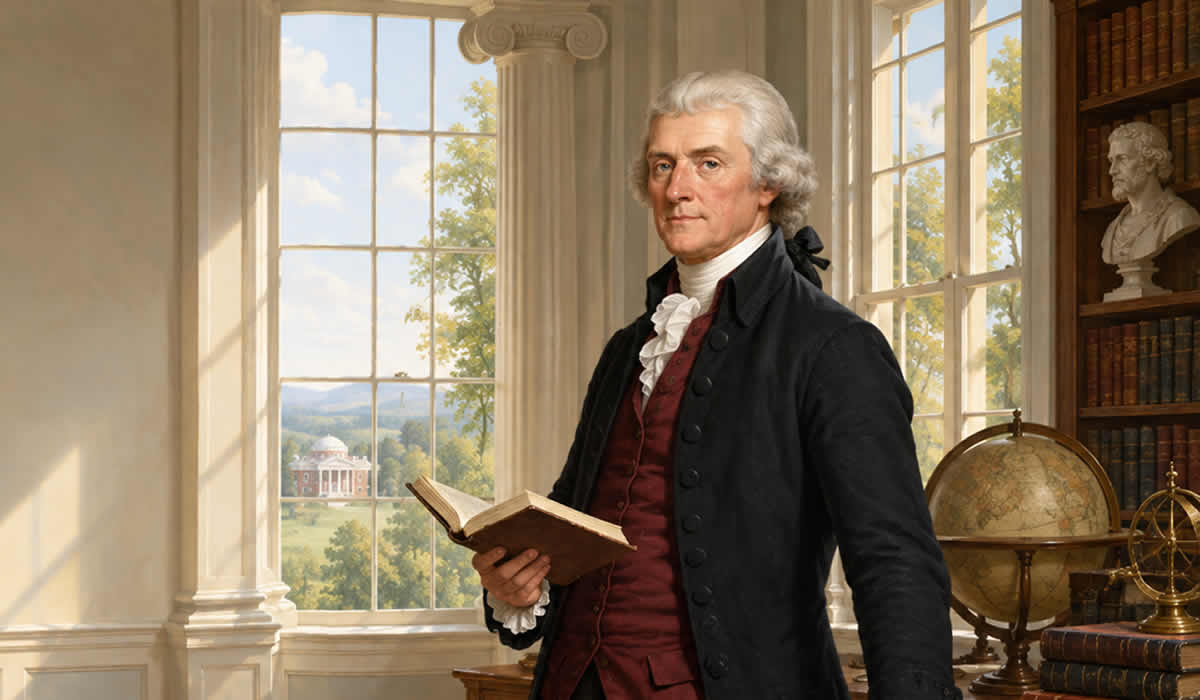
Thomas Jefferson wrote some of the most famous words in the history of freedom. He also owned hundreds of human beings, forced them to work for his benefit, and fathered children with Sally Hemings, an enslaved woman he owned. He spent decades enjoying the privileges of a slaveholding aristocrat while presenting himself as a champion of liberty. His defenders point to his intellect, his political achievements and the standards of his time. But Jefferson knew slavery was wrong enough to criticise it in writing. He simply failed to free most of the people whose freedom depended on him.
The man who helped declare America’s independence was perfectly comfortable denying independence to the people living under his own roof.
Is a prick because…
- He wrote “all men are created equal” while owning hundreds of slaves. Jefferson’s words became a founding principle of American democracy, yet he enslaved more than 600 people over his lifetime. He profited from their forced labour and kept most of those he personally owned enslaved until his death. His definition of liberty conveniently excluded the people making his lifestyle possible.
- His relationship with Sally Hemings exposed the darkest contradiction of his private life. Hemings was an enslaved woman Jefferson owned. DNA evidence and historical research strongly support that Jefferson fathered several of her children. Whatever the precise nature of their relationship, Hemings was not free to leave, and the enormous imbalance of power makes romanticising it deeply problematic. Jefferson fathered children with a woman whose freedom he controlled, yet did not free her during his lifetime.
- He criticised slavery without freeing the people he owned. Jefferson described slavery as a moral evil and warned of its dangers, but his actions repeatedly fell short of his rhetoric. Financial difficulties, political calculations and personal choices all played a role. He freed only a small number of the people he enslaved, leaving most to be sold or remain enslaved after his death.
- He helped build a country that protected slavery. The Declaration of Independence proclaimed liberty, but the new United States preserved slavery through its political and constitutional compromises. Jefferson was not solely responsible for that system, but he was one of its most influential architects and benefited directly from it.
- He supported the displacement of Native Americans. Jefferson’s vision of an expanding United States came at the expense of Indigenous nations. His administration pursued policies that pressured Native peoples to surrender land, and his writings contemplated their removal if they resisted American expansion. The Louisiana Purchase dramatically expanded US territory, strengthening the republic while intensifying the struggle over Indigenous land.
- His personal finances were built on exploitation. Jefferson repeatedly struggled with debt, yet the enslaved people on his estates remained a source of labour and wealth. At his death, his debts contributed to the sale of his estate and the people he had kept enslaved. Families were separated as human beings were sold to settle the financial affairs of a man celebrated as a champion of liberty.
- His reputation has been protected by his own eloquence. Jefferson was an extraordinary political writer, but beautifully worded principles do not excuse brutal contradictions. His place in history should not depend on how inspiring his quotations sound, but on how he treated the people over whom he held power.
Is not a prick because…
- He made a lasting contribution to American democracy. Jefferson was the principal author of the Declaration of Independence and served as the third US president. His political philosophy influenced democratic movements well beyond America.
- He did recognise slavery as a moral and political problem. His writings included criticism of slavery, and he took some steps against the international slave trade. Those actions matter, but they do not erase his lifelong ownership of enslaved people.
Thomas Jefferson helped give the world a language of liberty while refusing to practise it in his own household. His intellect and political achievements are undeniable. So is the hypocrisy. He knew how to write about freedom, knew slavery was a profound injustice, and still chose to benefit from it. The Declaration promised equality. Jefferson’s own life showed just how selectively he applied it.